Publications
Publications by categories in reversed chronological order. Generated by jekyll-scholar.
2026
- Real-time Reconstruction of Human Visual Perception from fMRIRishab S. Iyer, Jiaxin Cindy Tu, Cesar Kadir Torrico Villanueva, Anish Mahishi, Ross P. Kempner, Jacob S. Prince, Ernest W. Lo, Akash Bhowmick, Hritik Arasu, Amaar Chughtai, Elizabeth A. McDevitt, Paul S. Scotti, and Kenneth A. Norman. Live demo presented at NeurIPS 2025 , 2026
Real-time closed-loop neurofeedback based on functional magnetic resonance imaging (fMRI) has led to important scientific and clinical advances. However, the sophistication of the analysis methods used in real-time fMRI lags behind the state-of-the-art in fMRI decoding, largely due to computational factors: Most advanced decoding pipelines do not fit within the envelope of real-time processing, where the analysis needs to be conducted in a matter of seconds and without leveraging data acquired later in the session. Here, we present a real-time compatible adaptation of a computationally intensive state-of-the-art pipeline for reconstructing perceived natural images (MindEye2), and we demonstrate that reliable fine-grained decoding is still achievable in this setting. Using RT-Cloud, an open-source, scalable cloud-based platform, we performed a real-time scan where we decoded single-trial visual perception within seconds after an image was shown to the participant. Finally, we use simulated analyses to document the factors driving changes in performance from offline to real-time analysis. This work serves as a proof-of-concept that it is feasible to deploy these powerful fMRI decoding pipelines in real-time analysis, paving the way for their use in brain-computer interfaces for scientific discovery and clinical treatment.
@article{iyer2026realtime,
  title = {Real-time Reconstruction of Human Visual Perception from fMRI},
  author = {Iyer, Rishab S. and Tu, Jiaxin Cindy and Villanueva, Cesar Kadir Torrico and Mahishi, Anish and Kempner, Ross P. and Prince, Jacob S. and Lo, Ernest W. and Bhowmick, Akash and Arasu, Hritik and Chughtai, Amaar and McDevitt, Elizabeth A. and Scotti, Paul S. and Norman, Kenneth A.},
  year = {2026},
  publisher = {arXiv},
  url = {https://arxiv.org/abs/2607.22753},
}
2025
- StableSleep: Source-Free Test-Time Adaptation for Sleep Staging with Lightweight Safety RailsHritik Arasu and Faisal R Jahangiri2025
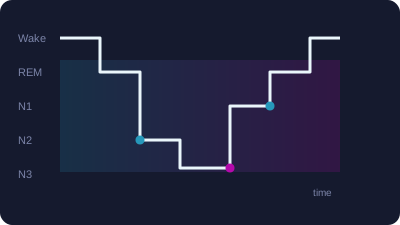
Sleep staging models often degrade when deployed on patients with unseen physiology or recording conditions. We propose a streaming, source-free test-time adaptation (TTA) recipe that combines entropy minimization (Tent) with Batch-Norm statistic refresh and two safety rails: an entropy gate to pause adaptation on uncertain windows and an EMA-based reset to reel back drift. On Sleep-EDF Expanded, using single-lead EEG (Fpz-Cz, 100 Hz, 30s epochs; R&K to AASM mapping), we show consistent gains over a frozen baseline at seconds-level latency and minimal memory, reporting per-stage metrics and Cohen’s kappa. The method is model-agnostic, requires no source data or patient calibration, and is practical for on-device or bedside use.
@article{arasu2025stable, title = {StableSleep: Source-Free Test-Time Adaptation for Sleep Staging with Lightweight Safety Rails}, author = {Arasu, Hritik and Jahangiri, Faisal R}, year = {2025}, publisher = {arXiv}, url = {https://arxiv.org/abs/2509.02982}, } - ArtifactGen: Benchmarking WGAN-GP vs Diffusion for Label-Aware EEG Artifact SynthesisHritik Arasu and Faisal R Jahangiri. Poster, GenAI4Health Workshop @ NeurIPS 2025 , 2025
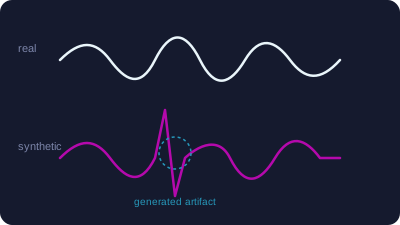
Artifacts in electroencephalography (EEG) – muscle, eye movement, electrode, chewing, and shiver – confound automated analysis yet are costly to label at scale. We study whether modern generative models can synthesize realistic, label-aware artifact segments suitable for augmentation and stress-testing. Using the TUH EEG Artifact (TUAR) corpus, we curate subject-wise splits and fixed-length multi-channel windows (e.g., 250 samples) with preprocessing tailored to each model (per-window min-max for adversarial training; per-recording/channel z-score for diffusion). We compare a conditional WGAN-GP with a projection discriminator to a 1D denoising diffusion model with classifier-free guidance, and evaluate along three axes: (i) fidelity via Welch band-power deltas, channel-covariance Frobenius distance, autocorrelation L2, and distributional metrics (MMD/PRD); (ii) specificity via class-conditional recovery with lightweight kNN/classifiers; and (iii) utility via augmentation effects on artifact recognition. In our setting, WGAN-GP achieves closer spectral alignment and lower MMD to real data, while both models exhibit weak class-conditional recovery, limiting immediate augmentation gains and revealing opportunities for stronger conditioning and coverage. We release a reproducible pipeline – data manifests, training configurations, and evaluation scripts – to establish a baseline for EEG artifact synthesis and to surface actionable failure modes for future work.
@article{arasu2025artifactgen, title = {ArtifactGen: Benchmarking WGAN-GP vs Diffusion for Label-Aware EEG Artifact Synthesis}, author = {Arasu, Hritik and Jahangiri, Faisal R}, year = {2025}, publisher = {arXiv}, url = {https://arxiv.org/abs/2509.08188}, } - Focused Ultrasound for Movement Disorders: Evidence from a Systematic Review of Efficacy and SafetyCherrender Brown, Razia Shaik, Hritik Arasu, and Faisal R. JahangiriJournal of Neurophysiological Monitoring, 2025
This systematic review evaluates the clinical efficacy and safety of focused ultrasound (FU) as a non-invasive neurosurgical modality for treating movement disorders, including Parkinson’s disease (PD), essential tremor (ET), and dystonia. FU enables precise targeting of deep brain structures without incisions or implanted devices, using advanced imaging guidance to ablate or modulate dysfunctional neural circuits. Magnetic resonance-guided focused ultrasound (MRgFUS), the most widely adopted technique, is examined in detail to assess therapeutic outcomes and procedural characteristics. Recent clinical studies consistently demonstrate that MRgFUS offers significant symptom relief, particularly in tremor reduction, with a favorable safety profile. Compared to conventional lesioning surgeries, MRgFUS produces smaller, more controlled lesions, minimizing adverse effects while preserving surrounding tissue integrity. In PD patients, improvements in tremors and bradykinesia have been observed following unilateral MRgFUS, which is currently considered the standard approach. However, bilateral applications remain under active investigation due to concerns regarding cumulative risk and long-term neurocognitive outcomes. Overall, MRgFUS represents a promising and precise intervention for select movement disorders, with growing evidence supporting its integration into neurosurgical practice. Further longitudinal studies are warranted to refine patient selection criteria, optimize targeting strategies, and evaluate the durability of clinical benefits.
@article{brownshaikarasu2025ultrasound,
  title = {Focused Ultrasound for Movement Disorders: Evidence from a Systematic Review of Efficacy and Safety},
  author = {Brown, Cherrender and Shaik, Razia and Arasu, Hritik and Jahangiri, Faisal R.},
  journal = {Journal of Neurophysiological Monitoring},
  volume = {3},
  number = {3},
  pages = {21-29},
  year = {2025},
  publisher = {Zenodo},
  url = {https://doi.org/10.5281/zenodo.16933232},
}